


“The advantage of LTSF in the sterilization of organic matter-contaminated surfaces and cannulated devices: an in vitro Study”
Authors:
Nelson Carreras, PhD1; Daniel Antonio Vázquez, PhD2; Alejandro Ramirez, Eng3; Tronje von den Hagen, PhD 4.
1Global Product Manager Consumables, 2Matachana Test Center Coordinator, 3 Global Product Manager Low Temperature Sterilizers, 4 Independent Consultant.
Key words:
LTSF, organic residues, cannulated devices, sterility assurance level
ABSTRACT
The sterilization of complex medical devices, especially those with contaminated surfaces, hollow structures, and narrow channels, remains a critical challenge in infection prevention and patient safety. This White Paper evaluates the efficacy of the Low Temperature Steam and Formaldehyde (LTSF) process in inactivating resistant spores on metallic surfaces and cannulated devices, adding the presence of organic residues within permissible limits defined by international standards.
To replicate real-world contamination scenarios, bovine serum albumin (BSA) — a widely used reference protein due to its strong adhesion to medical device surfaces—was employed. Additionally, animal tissues were introduced to mimic complex organic contamination and evaluate LTSF’s penetration capabilities in biological structures.
This in vitro study demonstrates that LTSF achieves a Sterility Assurance Level (SAL) of 10⁻⁶, even under challenging conditions where other conventional methods, such as ethylene oxide (EtO) and vaporized hydrogen peroxide (VHP), often exhibit reduced effectiveness. The combined action of saturated steam and formaldehyde ensure deep penetration into contaminated surfaces and complex geometries, inactivating microorganisms in hard-to-reach areas.
These findings highlight LTSF’s capability to surpass the limitations of manual cleaning and effectively decontaminate medical devices with complex organic contamination. This study represents the first phase of a broader evaluation of LTSF, which will continue with a second study (Part II) focused on endoscopes contaminated with proteins simulating clinical conditions, underscoring LTSF’s effectiveness as an advanced solution for the safe reprocessing of medical devices.
INTRODUCTION
Influence of residual contamination on Low Temperature Sterilization processes: permissible residue limits
Residual contamination on medical devices is one of the main factors affecting the effectiveness of sterilization processes, particularly low-temperature methods [1-3]. International standards, such as ISO 17665-1 [4] and ISO 15883-5 [5], establish permissible residue levels after the cleaning process, ensuring that patient safety is not compromised. These residues, which may include proteins, blood, minerals, or other inorganic materials, pose a considerable challenge for sterilization by potentially shielding microorganisms from inactivation.
To ensure proper hospital cleaning, ISO 15883-5:2021 establishes alert and action limits for various types of organic residues [5], as summarized in Table 1.
Standards such as ISO 15883-5 and AAMI TIR30 [5, 8] define residual protein limits per surface area (µg/cm²), while other organizations, such as DGSV [6] and KRINKO [7], set limits based on the total amount of protein per reusable medical device (µg per device).
Table 1. Permissible residue limits for medical devices according to standards.
| Standard or Organization | Protein limit per surface | Total protein limit in the RMD |
| ISO 15883-5:2021 [5] | ≤6,4 μg/cm² | NA |
| DGSV [6] | NA | ≤100 µg |
| KRINKO [7] | NA | ≤100 µg |
| AAMI TIR30 [8] | ≤3,0 µg/cm² | NA |
RMD – Reusable Medical Device; ISO – International Organization for Standardization; DGSV – German Society for Sterile Supply; KRINKO – Commission for Hospital Hygiene and Infection Prevention, Robert Koch Institute; AAMI TIR – Association for the Advancement of Medical Instrumentation, Technical Information Report; NA – not applicable.
Impact of residual contamination on Low Temperature Sterilization processes
Low temperature sterilization methods, such as EtO, VHP, or hydrogen peroxide plasma (HPP), are highly dependent on the effectiveness of pre-cleaning. Residual contamination can directly interfere with the sterilizing agent’s ability to reach and eliminate microorganisms. These residues act as physical barrier that preventing adequate agent penetration and thus shielding microorganisms from inactivation [1-3].
Surfaces contaminated with organic matter or biofilm can impede the diffusion of the sterilizing agent or alter the intended biochemical reaction which provoke the inactivation of microorganism, negatively affecting the sterilization of complex medical devices such as endoscopes.
- EtO sterilization relies heavily on thorough pre-cleaning. If residues remain, the gas may not fully penetrate the medical device, leaving areas unsterilized. Alfa et al., (1996) [1] demonstrated that while EtO is effective, its performance is highly dependent on the absence of residues, limiting its use in scenarios where minimal residual contamination is allowed.
- VHP and HPP sterilization: According to Prüfert-Freese (2020) [3], VHP has significant limitations in penetrating complex residues, such as proteins or biofilms, reducing its effectiveness on devices with challenging geometries or adherent residues. Similarly, Rutala et al., (2020) [2] found that VHP and HPP’s ability to eliminate microorganisms is limited in the presence of organic residues and/or high ionic forces. Additionally, the catalytic reactions of H₂O₂ with numerous metallic materials, for example, can reduce the concentration of the sterilizing agent over extended diffusion paths [10].
RESULTS
LTSF Sterilization on surfaces with organic matter (protein layers and animal tissues)
The efficacy of the LTSF sterilization process was initially evaluated to determine its Sterility Assurance Level (SAL) on metallic surfaces contaminated with proteins, representing residual organic matter that may remain after cleaning. This evaluation was conducted according to ISO 25424 [16], which outlines validation procedures for LTSF sterilization. Geobacillus stearothermophilus ATCC 7953 spores were specifically used as the biological indicator.
Protein Layer Evaluation
The sterilization program 60 °C was selected. Metallic carriers were inoculated with G. stearothermophilus spores and coated with variable amounts of Bovine Serum Albumin (BSA), a well-established contaminant model (Figure 1). BSA, one of the main proteins in blood serum, is commonly used as a reference due to its amphipathic nature and strong adherence to surfaces after washing and disinfection processes, as described by Sava et al. (2013) [11]. This protein is particularly suitable for representing protein residues in decontamination validation, as it simulates residues often found on medical devices.
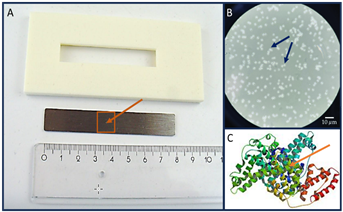
Figure 1. A. Metal plates (316L stainless Steel) used as test pieces and reference patterns for defining the field for the inoculum of G. stearothermophilus ATCC 9753 combined with BSA [12]. The orange arrow marks the area of the spore inoculation with the protein. B. Purified spores of G. stearothermophilus (ATCC 7953) under a phase-contrast microscope (100X) [13]. Blue arrows indicate the ellipsoidal shape of the spores. C. Crystal structure of BSA obtained by X-ray diffraction at 2.70 Å [14]. The orange arrow marks the hydrophobic domains within the protein. These regions, which are exposed in the presence of detergents, exhibit high affinity for the surfaces of surgical instruments.
To establish a standardized evaluation framework, the alert and action levels described in ISO 15883-5 [5] were used as reference points (Table 1). These limits define for the maximum permissible protein residues on medical devices post-cleaning and pre-sterilization. The metal plates were distributed in three different positions inside the sterilization chamber: near the loading door, unloading door, and center.
The results, summarized in Table 2, confirm that LTSF process achieved a SAL of 10⁻⁶ in the presence of protein residues on the metallic surfaces exceeding the action level (≥ 6.4 µg/cm²). This demonstrates LTSF’s ability to penetrate surfaces contaminated with proteins, successfully inactivating G. stearothermophilus spores even in presence of challenging contamination conditions [12].
Table 2. Microbiological results obtained after evaluating the microbicidal efficacy of LTSF sterilization in the presence of organic test soil (BSA) on metal plates.
| SURFACE SAMPLES | STERILIZATION CYCLES | SPORE RESISTANCE CHARACTERISTICS | SPORE SURVIVAL | TEST SOIL | SAL 10-6 according to ISO 25424 | Protein Assay Limits according to ISO 15883-5 | |||||
| Samples No. | LTSF 60°C program | DFA60°C value
(min) |
FBIO FA60°C
(min) |
CFU / plate after recovery | Incubation of TSB dilution | Bacterial Identification | Organic material (BSA quantity) on the carrier | ||||
| BI 1 | Cycle 000153 | 16.5 | 84.91 | 0 | – | – | 37 µg / plate 7.3 µg/cm2 |  |
˃ Action level ≥ 6.4 µg/cm2 | ||
| BI 2 | 0 | – | – | ||||||||
| BI 3 | 0 | – | – | ||||||||
| BI 4 | Untreated | 1.40 x10⁵ | + | Geobacillus stearothermophilus | |||||||
| BI 5 | Cycle 000153 | 84.38 | 0 | – | – | 17 µg / plate 3.4 µg/cm2 | |
˃ Alert level
≥ 3 µg/cm2 |
|||
| BI 6 | 0 | – | – | ||||||||
| BI 7 | 0 | – | – | ||||||||
| BI 8 | Untreated | 1.30 x10⁵ | + | Geobacillus stearothermophilus | |||||||
| BI 9 | Cycle 000153 | 85.41 | 0 | – | – | 9 µg / plate 1.8 µg/cm2 | |
˂ Alert level
≥ 3 µg/cm2 |
|||
| BI 10 | 0 | – | – | ||||||||
| BI 11 | 0 | – | |||||||||
| BI 12 | Untreated | 1.50 x10⁵ | + | Geobacillus stearothermophilus | |||||||
The metal plates are distributed in three different position into the chamber. [near loading door, unloading door, Center (C)]. Test soil: Bovine Serum Albumin (BSA). Sterility Assurance Level: SAL 10⁻⁶. Biological Indicator: BI. Decimal Reduction Value: D-value. Formaldehyde: FA. Biological Resistance Factor: Fbio. Colony Forming Unit: CFU. Tryptic Soy Broth: TSB..
Animal tissue Evaluation:
Following the promising results on protein-coated metallic surfaces, a second phase of the study was conducted to assess the capacity of LTSF to penetrate and sterilize biological tissues contaminated with spore. This phase was carried out in collaboration with Aseptium Ltd., which provided rat brain tissue samples inoculated with G. stearothermophilus spores (Figure 2).
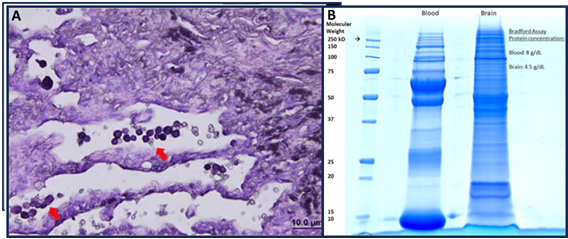
Figure 2. A. Histological section of mammalian tissue with spores (red arrows) under microscopic examination, adapted from Yang et al., 2021 [15]. While the image serves as a reference, the experiment in this study was conducted using rat brain tissue samples provided by Aseptium Ltd., embedded in 316L stainless steel plates and inoculated with G. stearothermophilus ATCC 9753. B. SDS-PAGE analysis of blood and brain tissue samples, provided by Aseptium Ltd. The results indicate that brain tissue contains a greater variety of proteins than blood, leading to significant physicochemical differences that may impact the penetrability of the sterilizing agent.
Brain tissue presents a more complex contamination challenge due to its multilayered cellular structures and dense extracellular matrix, which can act as a barrier to sterilant penetration. Despite these structural challenges, as summarized in Table 3, the results demonstrate that, LTSF was able to penetrate these structures and reach the spores for inactivation. This confirms that the sterilizing agent is effective not only on flat, metallic surfaces but also within intricate biological structures, where macromolecular matrices could serve as barriers to other sterilizing agents.
Table 3. Microbiological results of LTSF sterilization in the presence of rat brain tissue.
| SURFACE SAMPLES | STERILIZATION CYCLES | SPORE RESISTANCE CHARACTERISTICS | SPORE SURVIVAL | TEST SOIL | SAL 10-6 according to ISO 25424 | Protein Assay Criteria according to ISO 15883-5 | Protein Assay Criteria according to RKI | |||||
| Samples No. | LTSF 60°C program | DFA60°C value
(min) |
FBIO FA60° (min) | CFU / plate after recovery | Incubation of the TSB Eluate | Bacterial Identification | Tissue material on the Carrier
(protein quantity) |
|||||
| BI 1 | Cycle 000154 | 16.5 | 103.33 | 0 | – | – | 1,103 µg per plate 217 µg/cm2 | |
˃ Action level ≥ 6.4 µg/cm2 | ˃ Action level ≥ 100 µg per MD | ||
| BI 2 | 0 | – | – | |||||||||
| BI 3 | 0 | – | – | |||||||||
| BI 4 | 0 | – | – | |||||||||
| BI 5 | 0 | – | – | |||||||||
| BI 6 | 0 | – | – | |||||||||
| BI 7 | Untreated | 1.83 x10⁶ | + | Geobacillus stearothermophilus | ||||||||
Microbiological results were obtained from the evaluation of LTSF sterilization in the presence of rat brain tissue samples embedded in 316L stainless steel plates. Biological indicators (BI) were inoculated with G. stearothermophilus ATCC 9753 and distributed in three positions inside the sterilization chamber (near the loading door, unloading door, and center. Sterility Assurance Level: SAL 10⁻⁶. Biological Indicator: BI. Decimal Reduction Value: D-value. Formaldehyde: FA. Biological Resistance Factor: Fbio. Colony Forming Unit: CFU. Tryptic Soy Broth: TSB.
Furthermore, these results are extremely promising, as they confirm that, even in the presence of complex biological structures, LTSF can achieve a SAL of 10⁻⁶, fully meeting the requirements of ISO 25424 [16]. The ability of LTSF to penetrate complex tissue structures suggests its feasibility for reprocessing more challenging medical devices, including hollow devices and endoscopes.
| Spore inactivation through LTSF sterilization in the presence of residual contamination after use and cleaning, as permitted by regulation
The LTSF sterilization process is exceptionally effective, even when residue levels remain after cleaning that are within or exceed regulatory limits [5-7]. The combination of saturated steam and formaldehyde ensures penetration into contaminated surfaces, allowing for Geobacillus stearothermophilus spore inactivation—one of the most resistant microorganisms to LTSF sterilization—and achieving a SAL of 10⁻⁶. This is particularly crucial in cases where consistent manual cleaning cannot always be guaranteed, providing an additional layer of safety in the reprocessing of complex medical devices. |
LTSF Sterilization on hollow challenge devices (0.6 – 2 m Length, Ø 0.5 – 1 mm)
Following the promising results obtained on flat surfaces, an additional analysis was conducted to evaluate the penetration capacity of the LTSF sterilization process in hollow challenge devices. These Process Challenge Devices (PCD), made from Teflon tubes with a stainless-steel receptacle, were selected in accordance with internal volume dimensions specified in ISO 11140-6. Designed to simulate the most challenging sterilization conditions for long and narrow medical instruments, these PCDs were used to evaluate LTSF sterilization effectiveness in the presence of organic matter—a critical factor in medical device sterilization (Figure 3).

Figure 3. A. Borescope photograph of a Hollow Process Challenge Device (HPCD), illustrating its internal structure. B. Set of different Teflon HPCDs with different dimensions for the evaluation of the penetrability of the sterilizing agent. C. Spore-inoculated wires (0.29 mm diameter), used as biological indicators for monitoring LTSF sterilization cycles, inoculated with G. stearothermophilus (ATCC 7953) spores.
For this test, the standard sterilization program 60 °C was applied, using 0.29 mm-diameter metallic wire carriers inoculated with G. stearothermophilus spores. Additionally, protein in different concentrations was added to simulate real-life contamination, according to the alert and action levels specified in ISO 15883-5. The hollow PCDs used in this study measured between 0.6 and 2 meters in length, with internal diameters ranging from 0.5 to 1 mm, representing a worst-case scenario for sterilant penetration.
The results summarized in Table 4 demonstrate that, despite the complex geometry of hollow devices and the presence of proteins as organic residues, the LTSF process successfully inactivated G. stearothermophilus spores. Even in devices up to 2 meters long with internal diameters of 0.5 mm, the process achieved a SAL of 10⁻⁶, in compliance with ISO 15883-5 [5]. These findings are particularly significant, as they confirm that LTSF ensures complete spore inactivation even under conditions that allow minimal organic residues, in line with the alert levels permitted by the standard.
Table 4. Microbiological efficacy of LTSF sterilization in the presence of organic test soil in HPCDs
| HOLLOW SAMPLES | STERILIZATION CYCLES | SPORE RESISTANCE CHARACTERISTICS | SPORE SURVIVAL | TEST SOIL | ||||||||
| Samples No. – | Carrier + PCD description | LTSF 60°C program | DFA60°C value
(min) |
FBIO FA60°C
(min) |
CFU / plate After recovery | Incubation of the TSB Eluate | Identification | Organic material (BSA) on the carrier | SAL 10-6 according to ISO 25424 | Protein Assay Criteria according to ISO 15883-5 | ||
| BI 1 | Wire
+ PCD (Ø 0.7 mm X length 0,6 m) |
Untreated | 17,2 | 100.31 | 1.20 x10⁶ | + | Geobacillus stearothermophilus | na | |
|||
| BI 2 | Cycle 000154 | 0 | – | – | 0 µg/cm2 | |||||||
| BI 3 | 0 | – | – | 34 µg per plate 5.7 µg/cm2 | ˃ Alert level
≥ 3 µg/cm2 |
|||||||
| BI 4 | 0 | – | – | 14 µg per plate 2.3 µg/cm2 | ˂ Alert level
≥ 3 µg/cm2 |
|||||||
| BI 5 | 0 | – | – | 6 µg per plate 1 µg/cm2 | ˂ Alert level
≥ 3 µg/cm2 |
|||||||
| BI 6 | Wire
+ PCD (Ø 0.5 mm X length 1 m) |
Untreated | 101.15 | 1.35 x10⁶ | + | Geobacillus stearothermophilus | na | |
||||
| BI 7 | Cycle 000155 | 0 | – | – | 0 µg/cm2 | |||||||
| BI 8 | 0 | – | – | 34 µg per plate 5.7 µg/cm2 | ˃ Alert level
≥ 3 µg/cm2 |
|||||||
| BI 9 | 0 | – | – | 14 µg per plate 2.3 µg/cm2 | ˂ Alert level
≥ 3 µg/cm2 |
|||||||
| BI 10 | 0 | – | – | 6 µg per plate 1 µg/cm2 | ˂ Alert level
≥ 3 µg/cm2 |
|||||||
| BI 11 | Wire
+ PCD (Ø 0.5 mm X length 2 m) |
Untreated | 115.42 | 9.89 x10⁶ | + | Geobacillus stearothermophilus | na | |
||||
| BI 12 | Cycle 000156 | 0 | – | – | 0 µg/cm2 | |||||||
| BI 13 | 0 | – | – | 34 µg per plate 5.7 µg/cm2 | ˃ Alert level
≥ 3 µg/cm2 |
|||||||
| BI 14 | 0 | – | – | 14 µg per plate 2.3 µg/cm2 | ˂ Alert level
≥ 3 µg/cm2 |
|||||||
| BI 15 | 0 | – | – | 6 µg per plate 1 µg/cm2 | ˂ Alert level
≥ 3 µg/cm2 |
|||||||
| BI 16 | Wire
+ PCD (Ø 1 mm X length 1 m) |
Untreated | 99.87 | 1.13 x10⁶ | + | Geobacillus stearothermophilus | na | |
||||
| BI 17 | Cycle 000157 | 0 | – | – | 0 µg/cm2 | |||||||
| BI 18 | 0 | – | – | 34 µg per plate 5.7 µg/cm2 | ˃ Alert level
≥ 3 µg/cm2 |
|||||||
| BI 19 | 0 | – | – | 14 µg per plate 2.3 µg/cm2 | ˂ Alert level
≥ 3 µg/cm2 |
|||||||
| BI 20 | 0 | – | – | 6 µg per plate 1 µg/cm2 | ˂ Alert level
≥ 3 µg/cm2 |
|||||||
| BI 21 | Wire
+ PCD (Ø 1 mm X length 2 m) |
Untreated | 99.48 | 1.07 x10⁶ | + | Geobacillus stearothermophilus | na | |
||||
| BI 22 | Cycle 000158 | 0 | – | – | 0 µg/cm2 | |||||||
| BI 23 | 0 | – | – | 34 µg per plate 5.7 µg/cm2 | ˃ Alert level
≥ 3 µg/cm2 |
|||||||
| BI 24 | 0 | – | – | 14 µg per plate 2.3 µg/cm2 | ˂ Alert level
≥ 3 µg/cm2 |
|||||||
| BI 25 | 0 | – | – | 6 µg per plate 1 µg/cm2 | ˂ Alert level
≥ 3 µg/cm2 |
|||||||
Microbiological results obtained after evaluating the microbicidal efficacy of LTSF sterilization in presence of organic test soil (BSA) in PCDs. BI 1, 6, 11, 16, 21 are samples not sterilized. The metal plates are distributed in one position in middle of the chamber.
Moreover, the study confirms the ability of LTSF to penetrate the narrowest internal channels of medical devices, inactivating highly resistant microorganisms and ensuring a reliable sterilization process, even in conditions that challenge other low temperature sterilization technologies.
Next studies (Part II and Part III) will build upon these results by evaluating LTSF’s microbicidal efficacy (SAL 10-6) to inactivate spores in the presence of organic matter inside endoscope channels (Part II) and the 100% inactivation of biofilms in endoscopes and other complex hollow devices (Part III). As stated in Ruiz L.E. et al. (2014) [9], this kind of research is particularly relevant for improving infection control in endoscopy units, where biofilm formation remains a major challenge.
| Superior penetration power of LTSF in cannulated or hollow devices
One of the greatest challenges in the decontamination of cannulated or hollow medical devices is ensuring that sterilizing agents effectively reach all internal device surfaces. LTSF has demonstrated superior penetration capability, reaching hard-to-access areas where traditional methods, such as VHP, HPP, may fall short. Even in simulations with inadequate cleaning processes, LTSF has consistently achieved a SAL of 10⁻⁶, providing an extra layer of protection against human error or deficiencies in manual cleaning procedures. |
CONCLUSIONS
This White Paper has demonstrated the effectiveness and reliability of the Low temperature Steam and Formaldehyde (LTSF) sterilization process for a wide range of complex medical devices, from organic matter-contaminated metal surfaces to hollow devices, demonstrating its compliance with the most stringent international standards.
LTSF Sterilization on organic matter surfaces
Initial tests using metallic carriers contaminated with proteins, such as BSA, confirmed that LTSF achieves a SAL of 10⁻⁶, even in the presence of high organic loads superior to standards’ limits. Additionally, when applied to biological tissues (e.g., homogenized brain tissue), LTSF effectively penetrated cellular structures and inactivated embedded spores, reinforcing its suitability for clinical environments with complex contamination scenarios.
LTSF Sterilization of hollow challenge devices
The penetration capability of LTSF was evaluated in hollow devices up to 2 meters in length and with internal diameters as small as 0.5 mm. Despite the challenging geometry and the presence of protein residues, LTSF successfully achieved a SAL of 10⁻⁶, confirming its suitability for the sterilization of endoscopes and other medical devices with hard-to-clean internal channels.
| Special consideration: The Albarran channel is a specialized component found in certain urological endoscopes, designed to guide instruments such as catheters and guidewires during endoscopic procedures. Its internal structure includes a control cable, which significantly reduces its effective diameter, making it more challenging for sterilizing agents to penetrate and presenting an additional sterilization challenge.
However, in vitro tests conducted at Matachana Test Center (MATEC) in Germany have confirmed that LTSF is capable of achieving effective sterilization, even under these more restrictive conditions. |
The findings presented in this study demonstrates that LTSF is a highly effective and reliable sterilization method for a variety of complex medical devices, from organic-contaminated metallic surfaces to complex hollow instruments, meeting full compliance with the highest international standards.
REFERENCES
1 Alfa, M.J., DeGagne, P., Olson, N., & Puchalski, T. (1996). Comparison of ion plasma, vaporized hydrogen peroxide, and 100% ethylene oxide sterilizers to the 12/88 ethylene oxide gas sterilizer. Infection Control & Hospital Epidemiology, 17(2), 92-100. https://doi.org/10.1086/647276
2 Rutala, W.A., Gergen, M.F., Sickbert-Bennett, E.E., & Weber, D.J. (2020). Comparative evaluation of the microbicidal activity of low-temperature sterilization technologies to steam sterilization. Infection Control & Hospital Epidemiology, 41(5), 541-546. https://doi.org/10.1017/ice.2020.22
3 Prüfert-Freese, U. (2020). H₂O₂ Sterilisation – Erste Ergebnisse. Leiterin des Hygienelabors der MA 39.
4 ISO 17665. Sterilization of health care products — Moist heat — Requirements for the development, validation, and routine control of a sterilization process for medical devices. International Organization for Standardization.
5 ISO 15883-5:2021. Washer-disinfectors — Part 5: Test soils and methods for demonstrating cleaning efficacy. International Organization for Standardization.
6 DGSV e.V. (2020). Best practices in reprocessing and sterilization. Deutsche Gesellschaft für Sterilgutversorgung (German Society for Sterile Supply).
7 KRINKO. (2021). Recommendations for hospital hygiene and infection prevention. Kommission für Krankenhaushygiene und Infektionsprävention, Robert Koch Institute, Berlin.
8 AAMI TIR30:2011 – A compendium of processes, materials, test methods, and acceptance criteria for cleaning reusable medical devices. Association for the Advancement of Medical Instrumentation.
9 Ruiz, L.E., et al. (2024). Endoscope reprocessing standards and microbial studies. Central Service.
10 Xing, M., Xu, W., Dong, C., Bai, Y., Zeng, J., Zhou, Y., Zhang, J., & Yin, Y. (2018). Metal sulfides as excellent co-catalysts for H₂O₂ decomposition in advanced oxidation processes. Chem, 4(6), 1359-1372. https://doi.org/10.1016/J.CHEMPR.2018.03.002
11 Sava, A., Vatamanu, A., & Sava, M. (2013). Contaminants in sterilization: Analysis and guidelines for reducing protein residue. Central Service.
12 SMP GmbH. (2020). Examination of Low-Temperature Formaldehyde Sterilizer 130 LF with the Rapid Cycle Program 60 °C (90 min) Using Metal Plates with Different Contamination of BSA. Project number 31919-3. Test report.
13 Stier, P., & Kulozik, U. (2021). Submerged bioreactor production of Geobacillus stearothermophilus ATCC 7953 spores for use as bioindicators to validate hydrogen peroxide inactivation processes. Methods and Protocols, 4(63). https://doi.org/10.3390/mps4030063
14 Majorek, K.A., Porebski, P.J., Dayal, A., Zimmerman, M.D., Jablonska, K., Stewart, A.J., Chruszcz, M., & Minor, W. (2012). Structural and immunologic characterization of bovine, horse, and rabbit serum albumins. Molecular Immunology, 52(3), 174-182. https://doi.org/10.1016/j.molimm.2012.05.011
15 Yang, X., Song, Y., Liang, T., Wang, Q., Li, R., & Liu, W. (2021). Application of laser capture microdissection and PCR sequencing in the diagnosis of Coccidioides spp. infection: A case report and literature review in China. Emerging Microbes & Infections, 10, 1889931. https://doi.org/10.1080/22221751.2021.1889931
16 ISO 25424:2020 Sterilization of medical devices — Low-temperature steam and formaldehyde — Requirements for development, validation, and routine control of a sterilization process for medical devices. International Organization for Standardization.
Latest comments